
How Multi-Service Platforms Like Gojek Are Driving New Business Growth
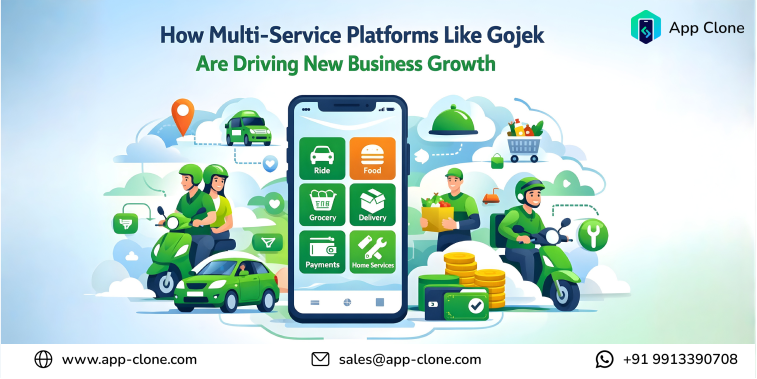
Super-apps like Gojek are altering how businesses think about growth and making money. These digital ecosystems package together high-volume services like ride-hailing, food delivery, and financial services into a single app, forging potent new paths to profit and market expansion.
This blog is for entrepreneurs, business leaders, and investors who believe we can do better through our digital efforts—creating modern, scalable models that redefine the tried-and-true models of yesterday, bring disruptive changes to legacy industries, and define innovative ways to scale up a service without adding people or cost. So, if you’re considering starting your own platform or competing against one, these insights will help you better understand this rapidly evolving space.
We’re going to dive into what enables these sites to develop several different streams of income and combine them effectively to maximize overall profitability. You will also learn the strategic benefits that these companies have in acquiring and retaining customers versus single-service competitors. Finally, we’ll lay out some of the unique operational efficiencies and addressable market expansion strategies that make these multi-service platforms such disruptive players in today’s digital economy.
Understanding the Multi-Service Platform Revolution
Defining the all-in-one digital ecosystem model
Much more than the typical packaged deals, though, these do-everything platforms present unified digital spaces where users can carry on with their quest for services of all sorts using a single app. This is the manifestation of consumer demand for convenience and digital-first solutions to problems. Companies are an example of how this approach influences consumer behavior and becomes the first point of digital touch for all sorts of use cases, leading to strong network effects that help both consumers and service providers.
Key characteristics that differentiate multi-service platforms
What makes these platforms unique is the integrated service architecture and common data insights across verticals. Rather than having siloed businesses for different services, multi-service platforms can integrate upsales and build comprehensive user profiles. They deepen their relationship with the customer in regular touchpoints and decrease the cost of purchase by widening service offerings to their existing users, versus always finding a new user for one specific offering.
Evolution from single-service to comprehensive solutions
Those companies that managed to establish themselves started transitioning as they found out that going niche had its limits. Earlier ride-hailing apps found that by branching into food delivery and payments, they could boost average customer usage and lifetime value. This development is a manifestation of evolving consumer demand for convenience and digital-first answers to problems. The platforms and solutions of today are the next logical steps towards all-encompassing digital assistants that will assist with any aspect of daily life, performed through an integrated stack.
Core Revenue Streams Driving Platform Profitability
Commission-based earnings from service transactions
Multiservice platforms earn large amounts of money on commissions from any services rendered within their environment. When users hail rides, order food, and request home services, platforms commonly charge service providers 15-30% for each transaction. This model is scalable by nature and becomes predictable revenue streams that feed into one another in the face of an ever-increasing usership (for various types of services).
Subscription fees for premium features and services
Premium subscription levels grant access to premium features such as priority booking, exclusive discounts, and ad-free experiences. Platforms are using the data of their users to identify high-value customers who are willing to pay a monthly fee in exchange for access and status benefits. These subscriptions mean dependable cash flow and growing customer lifetime value. What’s more, they can help to reduce dependence on transactional forms of revenue.
Advertising revenue from merchants and brands
Platform interfaces are monetized through “being paid for presence” of service providers and external brands, followed by targeting promotions to specific user segments and integrating sponsored content. Monetization of large user bases on platforms occurs through merchants who have access to such granular consumer behavior and preferences. This results in high-profit advertising that requires no extra service and minimal operational effort for the existing business.
Data monetization through consumer insights
Platforms gather a vast behavioral data set from dozens of service touchpoints, providing valuable insights into consumer preferences, expenditure patterns, and lifestyles. This customer pool then becomes an asset by serving as a revenue source in market research co-ops, selling trend analysis reports to businesses, and even offering extended targeting opportunities for advertising customers
Strategic Customer Acquisition and Retention Benefits
Cross-selling opportunities across multiple service categories
Single-service platforms actually block the natural flow of upselling by making it unnatural and forcing you to provide product expansions. Users who book rides via Gojek can access food delivery options in between rides. This natural interest leads to adoption beyond use cases and without pushing marketing.
Reduced customer acquisition costs through service bundling
When platforms package numerous services under one brand, the cost of acquiring customers becomes substantially lower. Instead of marketing acquisition to two different audiences for each service, a company can tap its existing users to cross over into new offerings and bring down the price tag on acquiring them.
Enhanced user engagement through frequent platform interactions
“Daily” usage on multiple services ensures continued engagement with the platform ecology. A user could be going from ordering breakfast to booking a ride and then paying their phone bill—all within the same app, which means that there are so many interaction points that result in an eventual deepening of brand connection and platform reliance.
Improved customer lifetime value through diversified offerings
A wide range of service packages can tremendously extend customer lifetime value by increasing revenue-generating opportunities on a per-user basis. Dozens of customers, after signing up to ride-hail, become regular users of food delivery, payments, and other services that add to total spending and lengthen the customer’s relationship with the platform.
Operational Efficiency Gains Through Platform Integration
Shared Technology Infrastructure Reducing Development Costs
Communities of multi-service platforms achieve huge cost efficiencies by creating once and deploying many. Instead of building separate apps, payment systems, and databases for each service, companies like Gojek use just one single tech stack that runs ride-hailing services, food delivery, and financial services all at the same time. This method reduces development costs by as much as 60% when developing independent solutions.
Centralized Logistics and Delivery Networks
Index Topic | Smart platforms can suboptimize their driver and delivery networks for the entire portfolio of services, which delivers significant efficiencies. One driver who services ride requests during the morning rush hour, delivers food at lunch, and handles package deliveries in the afternoon. This enables the assets to be used more effectively, whilst minimizing downtime overall, which in turn increases drivers’ income and decreases platform operating costs.
Unified Customer Support Systems
A single team of support personnel can work on everything from a ride complaint to an issue with payment across all services in the platform. Specialization: A rep in customer support gets turned into a jack-of-all-trades rather than a master of one thing. This results in faster problem solving and uniform service quality, while helping the enterprise achieve big savings on staff costs versus having individual support teams for each service vertical.
Streamlined Payment Processing Across All Services
Centralized payment networks allow pulling costs out through scale and no friction. Payment methods are stored once and accessed smoothly across ride-hailing, food delivery, and e-wallets. On platforms, the higher your transaction volume, the better rates you get with your payment processor, and buyers benefit from 1-click payments that improve conversion rate as well as cross-service flow.
Market Expansion Opportunities and Scalability
Geographic expansion with an established user base
Multi-service platforms have a huge jump start in any new market they enter, as they already know how to acquire users and can cross-sell services. When Gojek moved into Thailand and Vietnam from Indonesia, it didn’t need to totally reinvent the wheel; it brought its playbook and brand equity with it.
Rapid service category additions with minimal infrastructure investment
The magic of platform scale is that you don’t have to build an infrastructure for each new service. Once the basic technology platform is in place, however, platforms can roll out food delivery, financial services, or medical booking by using the exact same app interface—slashing costs and time to market relative to launching similar standalone services.
Competitive Advantages Over Traditional Single-Service Businesses
Higher barriers to entry for competitors
And multi-service nationwide platforms are creating entry barriers that go way beyond what any single service company can hope to match. New players are forced to create national service verticals all at once, which costs a lot of money in exploratory capital for each market. Gojek has succeeded because it offered ride-hailing, food delivery, payments, and logistics all under one roof—a feat that requires expertise in multiple sectors, highly complex technology infrastructure, and deep pockets of financial resources few startups can gain access to.
Superior data collection enabling personalized experiences
Platform companies gather rich behavioral data across various touchpoints, building in-depth profiles of users that specialty single-service businesses fall short of duplicating. When people use the same system to request ride shares, order food, and make payments, companies have an unprecedented opportunity to learn about their spending habits, location histories, and even lifestyle decisions. The company with one of the world’s largest stashes of data like this has this treasure trove to leverage toward uber that is personal recommendations, targeted offers, and predictive services to keep users sticking within the ecosystem.
Economic resilience through diversified revenue sources
Finally, revenue diversification serves as a barrier against market risk and adverse economic effects. Traditional businesses are also known to be disrupted when their core service struggles, but multi-service platforms can cushion losses in one area by absorbing gains in another. And during the pandemic, many platforms saw food delivery soar even as ride-sharing plummeted. This available reserve makes these businesses more appealing to investors and better able to withstand economic storms.
Network effects strengthen market position
Multi-service platforms are subject to strong network effects where each new user and service becomes more valuable for the entire ecosystem. The more drivers there are on the service, which is also true of any other marketplace business or social network, the more ride-hailing there is; the more restaurants that participate, the better the food delivery options; and the bigger the payment system grows through user adoption, the more merchant acceptance follows. From this network effect, a virtuous cycle emerges that becomes harder and harder for competitors to break or even mimic.
Conclusion
The multi-service platforms have changed the fabric of how companies look at growth and customer relations. These Gojeks show us putting multiple services under a single digital roof, generating some of the most profitable revenue paths available, enthralling customers longer, and delivering better market positions than traditional one-service companies. The ability to sell multiple services, collect a full view of customer information, and create operational efficiencies makes these platforms an advantage in the competitive landscape we see today.
The true opportunity is that these are customers who want convenience and simplicity in their everyday lives. Companies that can sell complementary services bundled at high-quality levels through all their offerings will additionally take more of the market.” If you have a business, think about how you could grow beyond your main line to offer a full customer experience—those who perfect this are the ones who will probably lead in their respective markets for years to come.
FAQ

Mohini Patel
Managing Director
Mohini Patel, with years of expertise in the IT and on-demand app industry, leads App Clone with a mission to support startups and enterprises through scalable, ready-made digital solutions. Her strong leadership, strategic mindset, and business insight drive innovation and ensure lasting client success across industries.
Explore Our Ready-Made On-Demand App Services
Explore our top-selling on-demand solutions and discover the perfect match for your business needs.


Grow your business quickly using our customizable Gojek Clone App and On-Demand App Clone. No matter your stage, we offer the right solution to help you launch and succeed.
Start Your Journey to Business Success Today!