 Skip to main content
Launch an AI-Powered Uber Clone App for Your Ride-Hailing Business
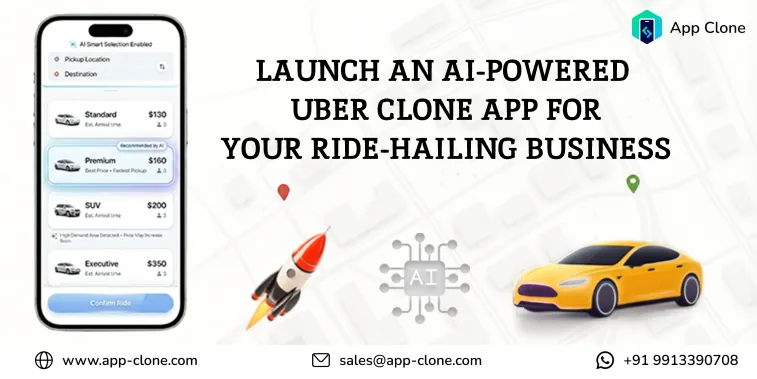
The ride-sharing market is rapidly growing, and savvy entrepreneurs are getting behind the wheel with AI technologies that outclass outdated taxi apps. If you are a business Owner, startup founder, or tech entrepreneur looking to lure your share of this $85 billion industry under your umbrella, then making an Uber clone app with AI integrations would place you well ahead in achieving the goal.
Building something that already exists is not the only goal when you want to create a ride-hailing app of your own. It’s about the construction of something elegant, immediate, and more user-friendly than what’s out there. AI disrupts everything from connecting drivers with riders to forecasting demand and dynamically routing trips.
We’ll give you a tour of the must-have AI features that get users connected and your business growing, along with the practical considerations before you start building. You will also find step-by-step tactics to launch your app successfully and get your first wave of loyal customers.
Understanding the Market Opportunity for AI-Powered Ride-Hailing Apps
Current market trends and growth projections in ride-hailing industry
The worldwide ride-hailing market has been growing like clothing, from $16.4 billion in 2013 to $85.8 billion in 2023, and is expected to reach a whopping figure of $230 billion by 2030. This is a strong CAGR of 15.2% (CAGR) which reflects the growing urban population, penetration of smartphones, and the evolving consumer trends in favor of shared mobility patterns.
Competitive advantages of AI integration over traditional ride-hailing platforms
Features enabled by AI make a great competitive differentiation feature for developers of an Uber clone app. Intelligent algorithms to find the best driver for riders’ fast pickups reduce waiting time by 35%. Dynamic pricing that ensures more money for drivers, whilst keeping our price fair and affordable. Machine learning probability forecasts demand patterns so predictive driver placement and surge-pricing optimization that old-school apps just can’t touch.
Revenue potential and monetization strategy
Revenue diversification is the game-changer for current ridesharing apps. Add to the standard commission fees the fact that AI allows for subscription models, premium ride experiences, and data monetization. Advanced analytics offer a pathway to increased revenue. This can be achieved through collaborations with local service providers, targeted advertising campaigns, and predictive maintenance strategies. These efforts could boost the platform’s overall profitability by a significant margin, potentially reaching 40%.
Essential AI Features That Drive User Engagement and Business Growth
Smart route optimization and dynamic pricing algorithms
Insisting on a better user experience, modern Uber clone app scripts are using AI-based route optimization. These algorithms take into account the dynamic traffic data, weather conditions, and historical patterns to optimize truck routing for the lowest fuel cost on a trip. Here we go. Lately, there’s been a lot of talk about dynamic pricing and whether it’s actually the way to solve surge pricing concerns, or if it could potentially make things worse during peak times. In peak demand periods, this game theory-backed pricing algorithm enables the highest driver payoff based on current rides and, compared to normal fares in normal times, retains reasonable fare levels throughout low demand periods.
Predictive demand forecasting and driver allocation
Data-driven On-demand forecasting. It will be an AI-powered, disruptive demand forecasting technology that rewrites how ride-hailing networks keep healthy driver fleets. Even machine understanding algorithms are at work, being fed local weather data, determining what activities are happening across the city, and accounting for user conventions to spit out predictions of demand for rides several hours ahead. This enables drivers to actively place themselves in high-demand zones, resulting in less downtime and more completed rides on the app. Intelligent allocation systems take these into account, as well as drivers’ preferences, fuel density, and distance from the Hulk to get best-of-both-worlds allocations.
Personalized user experience through machine learning
Through machine learning algorithms, we are capable of developing personalized experiences based on your user preferences, travel history, and booking movements. Over time, the system learns which are your favorite goals, vehicles you like, and which times of day you usually get in transit versus when you stay put, providing personalized recommendations.
Real-time safety monitoring and fraud detection
Sophisticated AI systems are always looking for random anomalies and unexpected deviations in rides, advising drivers and notifying them of threats to their safety. It uses behavioural analytics to identify real-time tendencies of fake accounts, and payment or driver fraud. The machine learning algorithms study the driving pattern, abrupt diversion from the driver’s scheduled route, and emergency signals for rapid response on safety matters. These smart monitoring systems deliver a haven that enables trust between users and the platform, ensuring riders and drivers are rescued safely.
Technical Requirements and Development Considerations
Choosing the Right Technology Stack for Scalability
A powerful tech stack to support millions of users and transactions, Uber clone app development doesn’t really need the hardest programming, but it needs a solid architecture that can ensure all operations are running smoothly. For cross-platform mobile development, you can use either React Native or Flutter and Node. JS or Django as backend APIs. PostgreSQL and Redis manage complex relational data and real-time operations (e.g., driver tracking or ride matching algorithms).
API Integrations for Payment Gateways and Mapping Services
Payment processing, which super easily links to major gateways including Stripe / PayPal / regional gateways so that customers genuinely spend for what they consume, needs to be switched on. Google Maps API or Mapbox is capable of providing your core location services, route optimization, and current traffic conditions. These are the integrations that power your ride-sharing platform’s essential features.
Cloud Infrastructure Setup for Handling High Traffic Volumes
An AWS, Google Cloud, or Azure will automatically scale up and down with demand profiles over the period of a day. Load balancers handle incoming requests and route them to the most powerful servers, while content delivery networks (CDNs) distribute static content globally around your app for faster performance. Kubernetes and Graceful Degradation: Deploy your Uber Clone App, in its respective geographical area, to get timely requests.
Building Core App Components for Maximum Market Impact
User-friendly passenger interface with AI-powered booking
The seamless passenger experience starts with the intelligent booking system, which records user preferences and predicts ride patterns. With features like one-tap booking, pricing estimation in real time, and an intelligent routing optimized using machine learning algorithms. A place that becomes intuitive as the interface learns over time about the person and automatically updates itself to suggest the best pickup points based on current traffic conditions, most commonly traveled from.
Driver app with intelligent trip matching and earnings optimization
This driver engagement heavily depends on smart trip assignments, which best maximize earnings and minimize dead miles between rides. Drivers’ location, traffic patterns, and historical data should be used by advanced algorithms to recommend the most lucrative routes along with the time of peak hours. The app needs to offer features that allow drivers to track earnings in real-time, calculate fuel costs for a given route or job, and provide driving performance analytics based on said data so they can know when and where their best time is being put to use.
Admin panel with comprehensive analytics and fleet management
A robust admin dashboard gives operators visibility into the performance of their business through real-time metrics that help them track driver utilization, passenger demand trends, and revenue streams. The panel also includes automatic fraud detection systems, dynamic pricing controls, and fleet optimization tools that can target underperforming vehicles or routes. With this feature, managers can understand how the demands are spread across various throughput regions and deploy their assets accordingly.
Customer support automation using AI chatbots
They deploy intelligent chatbots to reduce response times and operational costs by answering common passenger and driver inquiries around the clock.” These AIs should make it slip and slide to the heavy lifting of complex problems on behalf of human agents as they deal with queries regarding bookings, payments, account maintenance, etc. Its state-of-the-art natural language processing capabilities allow it to quickly learn exactly who it’s speaking with, enabling the system to ultimately deliver working solutions that are contextualized around this knowledge for much higher and overall user satisfaction rates.
Implementing Robust Security and Compliance Measures
Data Protection Protocols and User Privacy Safeguards
To be a privacy-protecting Uber clone app, let it encrypt communications and location data between users in transit with end-to-end encryption. Your app would also need to audit strong data anonymization against sensor data, both to hide rider/driver identity and facilitate operational analytics. Real-time data deletion mechanisms to ensure that any sensitive information is deleted once a ride has concluded, and require users to exercise fine privacy controls over what personal information should be shared with individual apps.
Payment Security and Fraud Prevention Systems
Machine Learning-based advanced fraud detection algorithms can recognize suspicious transaction patterns and block unauthorized access to user accounts. In addition to allowing consumers to tokenize their saved payment info, your ridesharing platform should also integrate with multiple PCI DSS-compliant payment gateways. In addition to allowing consumers to tokenize their saved payment info, your ridesharing platform should also integrate with multiple PCI DSS-compliant payment gateways.
Regulatory Compliance Across Different Markets
In order to successfully operate in more jurisdictions, it’s essential to understand locally applicable transportation regulation and how it is actually applied — especially with respect to driver employment classification as well as laws around data protection, such as the GDPR. Your Uber clone app must therefore have flexible compliance modules that would automatically adjust to the regional requirements, whether it be a licensing verification system or tax reporting instruments. Cleaning audits and legal framework updates guarantee that your platform is in compliance with the law as per the regulations of every target market.
Strategic Launch and User Acquisition Tactics
Beta Testing with Targeted User Groups for Feedback Optimization
Begin with a closed beta testing program for certain segments of the user base, e.g., daily commuters and frequent ride-hail users. Target early adopters who actively use transportation apps so that these individuals can help provide feedback on AI capabilities. Implement in-app surveys, user interviews, and analytics tracking to create feedback loops that signal pain points prior to your full release. This way, you would personalize the AI algorithms and the overall experience of your Uber clone app for real-world usage scenarios.
Marketing Campaigns Leveraging AI Capabilities as Differentiators
Frame your app’s AI features as leaders in marketing content, emphasizing smart route optimization, predictive pricing, and custom user journeys. Create demo footage to illustrate how AI helps reduce wait times and ensure accurate ETAs versus basic ride-hailing platforms. By relying on social media campaigns and content marketing, you can help potential users understand how smart matching algorithms and dynamic pricing provide the better value they expect.
Driver Onboarding Strategies and Incentive Programs
To ensure the program was securely stored, for example, drivers who consistently get high ratings and also rely on a set number of rides during specific times of day would be entitled to enter a draw following their fourth transaction. The nationwide scale of developing candidates through sign-on bonuses, rookie drivers continuing to earn operations, and pay-for-performance programs is all helping. We digitally review identification documents for speedy approval behind the wheel. We also use AI for background information verification. It means setting the community groups for drivers / giving them regular practice on how to use this app in a proper way.
Partnership Opportunities with Local Businesses and Transportation Hubs
Business site — Partner With Airports, Hotels, Malls, and Companies. Add load ride credits through nearby businesses as an employee benefit or customer reward program. Partner with event venues and entertainment districts for exclusive transportation services. These types of strategic partnerships create a consistent demand and have lower customer acquisition costs (CAC) during said partnerships through referral programs and cross-promotional channels.
Conclusion
In order to launch your AI-driven ride-hailing startup, you need to have the key fundamentals in place. We then review the size of the market opportunity, but highlight that it all comes down to executing algorithmic features such as predictive routing, dynamic pricing, and personalised recommendations that keep users returning. You will need a tight technical architecture that collects the necessary components of your app (for example, real-time tracking and payment processing), and you also need to build in security mechanisms to ensure customer data is safe, as well as build trust.
The point is to start out smart, with a well-defined user acquisition strategy that leverages your AI strengths compared to traditional ride-hailing. Ensure that your AI functionalities are plugging real holes in the market — quicker pickup times, smarter route management, profitable pricing for both drivers and passengers. Compete on fewer elements at a time. Focus on the top few AI features you are really good at, perfect them, and use those as your main sales points when attracting your first wave of users and drivers.
FAQ

Mohini Patel
Managing Director
Mohini Patel, with years of expertise in the IT and on-demand app industry, leads App Clone with a mission to support startups and enterprises through scalable, ready-made digital solutions. Her strong leadership, strategic mindset, and business insight drive innovation and ensure lasting client success across industries.
Explore Our Ready-Made On-Demand App Services
Explore our top-selling on-demand solutions and discover the perfect match for your business needs.





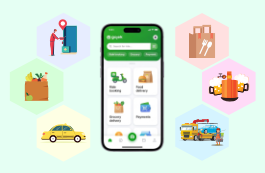

Grow your business quickly using our customizable Gojek Clone App and On-Demand App Clone. No matter your stage, we offer the right solution to help you launch and succeed.
Start Your Journey to Business Success Today!